Why Are Mineral Wools a Popular Choice for Global Buyers?
Why are Mineral Wools a popular choice for global buyers? The answer often begins with practical demands on a building site. Mineral wool products can provide thermal insulation, help reduce sound transmission, and offer fire-resistant performance when selected and installed according to their specifications. Buyers may find them in batts, boards, or loose-fill forms, making it easier to match products to walls, roofs, floors, and industrial equipment. One material, several uses.
For purchasing teams, consistent product data matters as much as headline performance. Density, thickness, facing, and declared thermal values can affect suitability, handling, and total project cost. Clear technical documents help buyers compare suppliers and reduce guesswork across regions. Still, a product label alone cannot guarantee results. Gaps around pipes, compressed batts, or moisture exposure can undermine performance, and installation guidance deserves close attention.
Mineral Wools also appeal to buyers managing varied climates and building types. Their non-combustible characteristics can support fire-safety strategies, but requirements differ by application and local building standards. That detail is easy to overlook. Freight costs, packaging, availability, and cutting waste also shape the final decision. A lower unit price may not be the better value if products arrive late or require extensive trimming. Buyers should check current test reports, installation instructions, and project-specific requirements with qualified professionals. No insulation choice is perfect; the best fit depends on the assembly, budget, and workmanship available. Looking at these factors explains why Mineral Wools remain widely considered—and why careful comparison still matters.
What Mineral Wool Is: Rock and Slag Fibers Bound into Insulation Products
Mineral wool is made by melting natural rock, often basalt, or industrial slag, then drawing the molten material into fine fibers. The fibers form a tangled, airy mat. A small amount of binder typically helps hold them in boards, batts, or loose-fill products. It looks simple. Its structure is doing the work: trapped air slows heat flow, while the dense fibers can also help absorb sound.
The U.S. Department of Energy’s insulation guidance gives mineral wool an approximate R-value of 3.0–3.3 per inch. R-value measures resistance to heat flow; actual performance depends on thickness and installation. Mineral wool is also noncombustible, though facings and binders may affect a product’s fire behavior. Check the product data sheet, not just the category name. Fiber diameter, density, and binder type vary, and that variation matters. A cut edge can shed fibers, too, so careful handling and fitted installation are practical details worth respecting. These materials are often described as uniform, but they are not identical.
How Mineral Wool Is Made: Melted Feedstock Spun into Fine Fibers
Mineral wool begins as a carefully proportioned mineral feedstock. Depending on the product, this may include basalt, recycled glass, or other mineral materials. The batch enters a furnace and melts at high temperatures. It becomes a glowing, viscous liquid. That molten stream then meets fast-spinning wheels or a controlled airflow, which draws it into fine fibers. The process resembles pulling sugar threads, but the material and temperatures are entirely different.
Fiber formation is a critical step. Operators monitor melt flow, wheel speed, and fiber consistency because small changes can affect the finished product. A binder may be added to help the fibers hold together. The soft wool then passes through a curing oven, where heat sets its shape. It is cooled, trimmed, and cut into batts, rolls, or boards. Careful handling matters. Loose fibers and uneven density can complicate later installation, even when a product looks uniform at first glance.
Manufacturers also check dimensions, density, and thermal performance before products are packaged. These checks help buyers compare materials for insulation and sound control, though the right specification depends on the building and application. The manufacturing line can look precise, yet no process is flawless. Fiber distribution may vary, and real-world performance still depends on correct installation and dry, suitable conditions.
Why Are Mineral Wools a Popular Choice for Global Buyers? — How Mineral Wool Is Made: Melted Feedstock Spun into Fine Fibers
| Dimension | Typical Material or Process | Practical Significance |
| Primary feedstock | Rock wool is generally made from mineral rock such as basalt and dolomite; glass wool is made mainly from sand and recycled glass. | Different mineral inputs allow manufacturers to produce distinct fiber products and use recycled or naturally occurring raw materials. |
| Melting | Prepared feedstock is heated in a furnace until it becomes molten. The required temperature depends on the composition and the production process. | Melting creates the liquid material needed for fiber formation; it is an energy-intensive stage of production. |
| Fiber formation | The molten material is converted into fine fibers, commonly by high-speed spinning or drawing processes. | Interconnected fibers form a porous structure that traps still air, helping the product resist heat transfer. |
| Product formation | Fibers are collected into a mat or wool layer. A binder may be added, and the material is shaped and cured for the intended product. | Density, thickness, and form can be adapted for applications such as batts, boards, pipe sections, or loose-fill products. |
| Thermal insulation | Many commercial mineral-wool products have declared thermal conductivity values around 0.030–0.045 W/(m·K); actual values vary by product and test conditions. | Low thermal conductivity can reduce heat flow through building envelopes and insulated equipment. |
| Fire performance | Mineral fibers are inorganic and generally non-combustible; the fire classification of a finished product depends on its composition, binder, facing, and applicable test standard. | Fire performance is an important consideration in building and industrial specifications. Buyers should check the product’s tested classification. |
| Sound absorption | The open, fibrous structure can absorb sound; performance depends on thickness, density, installation, and frequency. | Mineral wool is used in some wall, ceiling, floor, and equipment systems to help manage sound transmission and reverberation. |
| Moisture considerations | Many mineral-wool products are water-repellent, but they are not automatically waterproof. Product properties vary, and installation details matter. | Appropriate drainage, weather protection, and vapor-control design help maintain insulation performance in the intended assembly. |
| Common buyer applications | Building insulation, HVAC systems, fire-protection assemblies, and industrial or process-equipment insulation. | A range of product forms and performance characteristics makes mineral wool suitable for diverse construction and industrial requirements. |
Note: Values and performance characteristics are product-specific. Buyers should consult the relevant technical data sheet, declared performance, and local building-code requirements.
Thermal Performance: Typical Conductivity of 0.030–0.045 W/(m·K)
Mineral wool’s thermal conductivity commonly falls between 0.030 and 0.045 W/(m·K), depending on product density, structure, and test conditions. Lower conductivity means less heat passes through a given thickness. For example, a 100 mm layer within this range has an approximate thermal resistance of 2.2–3.3 m²·K/W, calculated as thickness divided by conductivity. This is a useful comparison, not a whole-wall performance promise.
Reliable figures depend on how samples are conditioned and tested. ASTM C518 specifies a heat-flow-meter method for measuring steady-state thermal transmission, while ISO 10456 addresses declared and design thermal values for building materials. Buyers should check which value a technical sheet reports, along with thickness and test conditions. Small differences matter. A damp, compressed, or poorly fitted layer may perform differently from a laboratory sample. Site gaps around pipes or framing can also create heat paths, even when the insulation itself has a low conductivity. The number deserves attention, but installation deserves more.
Why Are Mineral Wools a Popular Choice for Global Buyers?
Typical thermal conductivity ranges for common insulation materials
Mineral wool typically has a thermal conductivity of 0.030–0.045 W/(m·K). Lower conductivity indicates less heat transfer for a given thickness; actual values vary with product, density, and test conditions.
Fire and Acoustic Benefits: A1 Classification and Absorption up to αw 1.00
Mineral wool’s fire performance matters in walls, ceilings, and service areas where safety cannot rely on appearance alone. Under EN 13501-1, A1 is the highest reaction-to-fire class, indicating no contribution to fire under the standard’s test conditions. It is not a promise that every installed wall is fireproof: facings, joints, fixings, and the full assembly also matter. Details matter.
Acoustic performance is similarly specific. Some mineral-wool products reach a weighted sound absorption coefficient, αw, of 1.00 when tested to ISO 354 and rated under ISO 11654. In practical terms, that indicates very high absorption across the tested frequency range, not complete silence in a room.
The World Health Organization’s 2011 report, Burden of disease from environmental noise, estimated that traffic noise caused at least one million healthy life-years to be lost annually in western Europe. That finding gives sound control real public-health context, though it does not measure mineral wool itself.
A clear specification should identify thickness, mounting method, test standard, and the tested product configuration. A ceiling panel fitted with an air gap may perform differently from the same material fixed directly to a surface. Small installation choices can change the result. And published ratings can be easy to overread. Check the test report, not just the headline figure.
Where Global Buyers Use Mineral Wool: Buildings, Industry, and Infrastructure
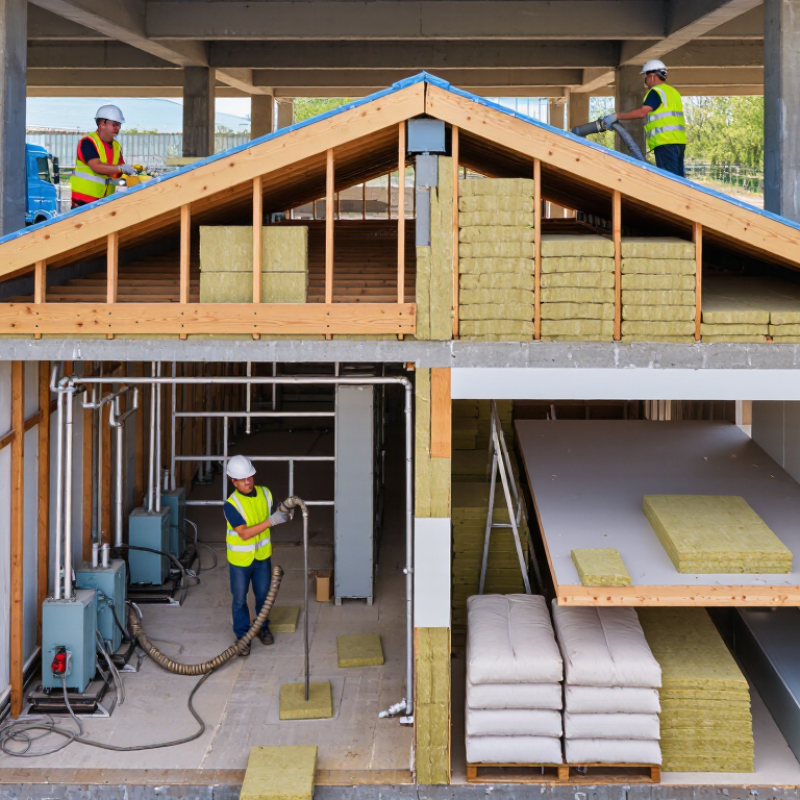
Mineral wool appears in homes, offices, factories, and transport infrastructure because it combines thermal insulation with sound absorption and fire resistance. In buildings, installers fit batts between timber studs, place rigid boards on exterior walls, or add insulation above ceilings. The International Energy Agency’s Buildings report estimates that buildings account for about 30% of global final energy consumption. Better insulation can help reduce heating and cooling demand, though results depend on installation quality, climate, and building design. Small gaps matter.
Industrial sites use mineral wool to insulate boilers, pipes, tanks, and process equipment. A maintenance worker may encounter it behind a removable metal jacket around a hot pipe. In infrastructure, it can be used in rail and road noise barriers, tunnels, and building systems around stations. The Global Status Report for Buildings and Construction, published by the UN Environment Programme, reports that buildings and construction represented 37% of global energy- and process-related CO₂ emissions in 2022. That figure describes the sector, not mineral wool’s individual impact. Performance also varies with moisture control and upkeep; insulation alone cannot fix a poorly designed building. Some project data are imperfect, so buyers should compare tested product specifications and installation details, not rely on broad claims.