Mon - Fri 8:00AM - 5:00PM Central
1150 SE Hamblen Rd, Lee's Summit, MO 64081
Choosing the right Dual Torch Pipeline Welding Machine can influence weld consistency, labor efficiency, and project safety. Global buyers often compare torch design, pipe diameter range, welding speed, power requirements, and maintenance access. A machine that performs well in a workshop may struggle on a windy pipeline site. Real conditions matter.
This guide presents ten leading options for international purchasing teams, contractors, and fabrication specialists. Each machine is considered through practical criteria, including arc stability, synchronized torch control, operator visibility, cooling performance, and spare-parts availability. Product documentation, manufacturer experience, and reported field performance also deserve close attention. Reliable technical support can matter as much as the initial purchase price.
Small details can decide the outcome. A clear control panel helps operators adjust settings quickly. Strong cable protection reduces damage near steel sections and abrasive ground. Easy torch alignment can save valuable setup time. However, no ranking is perfect. Regional voltage differences, local service capacity, and varying welding procedures may change the best choice. Buyers should verify certifications, compatibility, warranty terms, and training support before ordering. Careful testing remains essential.
Not every powerful machine is practical.
Fit matters most.
The following selection aims to provide a balanced starting point for comparison. It combines technical performance with usability, durability, and long-term operating value. With accurate specifications and realistic project requirements, global buyers can make a more confident decision.
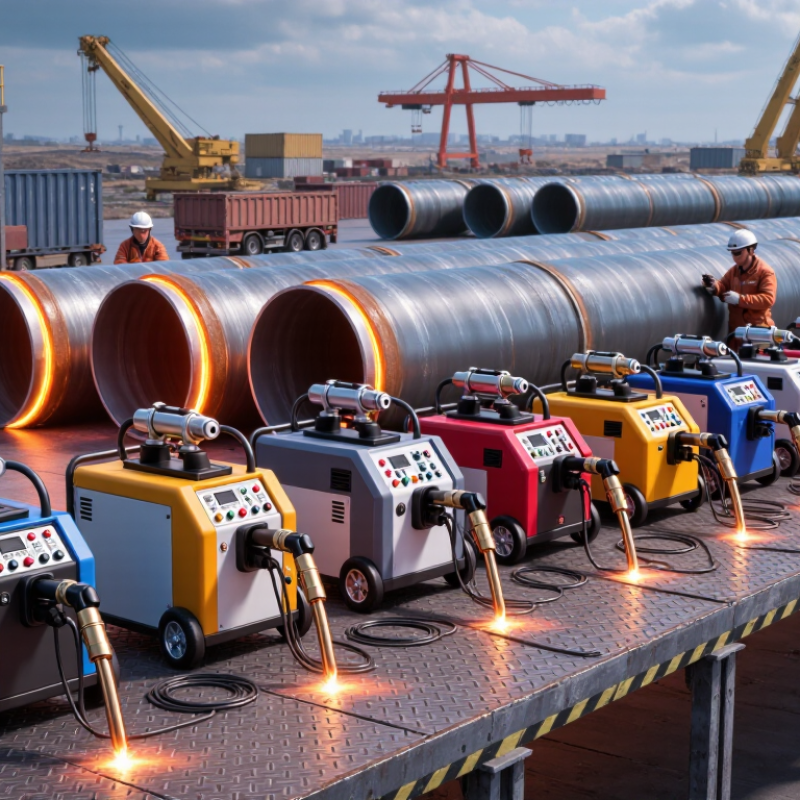
Dual torch pipeline welding machines are automated systems designed to weld pipe joints with two welding torches working together. A tracked carriage travels around the pipe while both torches follow the joint line. Each torch has independent control over current, voltage, wire speed, and travel position.
One torch often starts slightly ahead of the other. This spacing creates a controlled sequence of heat around the joint. Depending on the welding procedure, the first torch can support penetration, while the second adds filler metal and improves deposition speed.
The result may be faster production and more consistent weld profiles. Not always.
Pipe diameter, wall thickness, joint preparation, and welding position affect performance. On a 24-inch pipe, even a small alignment error can produce uneven bead width. Guide wheels, seam sensors, and adjustable torch mounts help correct this problem. They do not remove it completely.
Before operation, experienced technicians confirm the welding procedure, gas flow, wire condition, and torch angle. They also inspect the carriage path for dirt, scale, or damaged tracks. A stable power supply matters. So does operator judgment.
Field conditions can be imperfect. Wind may disturb shielding gas, and temperature changes can affect equipment movement. Operators should monitor arc behavior and inspect completed passes. Automated travel improves repeatability, but it cannot replace qualified welding oversight or careful inspection.
Comparing the top 10 dual torch pipeline welding machines requires more than checking output current. Start with weld quality, torch alignment, and travel consistency. Two torches should maintain an even arc across the joint, even when pipe diameter changes. Inspect the control system closely. Stable current, adjustable wire speed, and responsive arc correction reduce visible ripples and uneven penetration. Ask for test records on the materials and wall thicknesses you actually use.
Duty cycle matters during long pipeline sections. A machine that performs well for ten minutes may struggle after several hours. Check cooling design, cable length, power requirements, and service access. Torch spacing is another practical detail. Poor spacing can create heat concentration on one side of a 24-inch pipe.
Verify travel speed under load, not only in catalog conditions. High speed sounds impressive, but it can reduce fusion if settings are not balanced. A larger screen is useful, though it cannot replace skilled adjustment.
Tips: Compare identical weld procedures across all ten machines. Record amperage, voltage, travel speed, bead width, and repair rates. Review independent inspection results when available. Do not trust one impressive demonstration. A perfect sample may hide difficult starts, awkward access, or overheating. I would also leave room for operator feedback; experienced welders often notice vibration and control lag before instruments reveal them. Safety functions, documented maintenance, and local compliance should be verified before purchase.
Top 10 Dual Torch Pipeline Welding Machines by Technical Capability
Technical capability matters more than advertised output. The strongest dual torch pipeline welding machines combine synchronized travel, independent current control, real-time arc monitoring, and automatic seam tracking. A practical top ten includes machines with tandem wire feed, dual-process MIG capability, narrow-gap welding, orbital control, adaptive voltage regulation, hot-wire TIG support, remote parameter logging, high-duty-cycle cooling, all-position operation, and modular clamping. These features support repeatable welds on long pipe sections. They also help operators maintain heat input within approved welding procedures.
Technical capability matters more than advertised output.
The International Federation of Robotics reported 541,302 industrial robot installations worldwide in 2023. That figure confirms growing confidence in automated production, but pipeline welding has harsher conditions. Dust, wind, ovality, and imperfect fit-up can disrupt automation. The American Welding Society identifies welder availability as a continuing industry concern, making intuitive controls and training records increasingly valuable. Still, automation is not magic. A machine may claim 90% duty cycle, yet field performance can fall sharply with poor cooling or unstable power.
Buyers should compare torch alignment tolerance, wire-feed accuracy, data traceability, and compliance with API 1104 or ISO 3834 quality systems. Machines with dual independent torches can shorten cycle time, but only when synchronization remains stable around the full circumference. I have seen impressive demonstrations fail after minor pipe misalignment. That weakness deserves attention. A reliable evaluation should include production trials, destructive testing, maintenance access, and operator feedback before purchase.
Top 10 Dual Torch Pipeline Welding Machines for Global Buyers should be judged beyond torch count. Global Standards, Welding Applications, and Regional Compatibility matter more than impressive brochure figures. In 2023, world crude steel production reached about 1.89 billion tonnes, according to World Steel Association’s World Steel in Figures 2024. That volume supports continuous demand for reliable pipeline fabrication and repair equipment.
For field selection, verify compliance with IEC 60974-1 for arc-welding power sources, ISO 15614-1 for welding procedure qualification, and ISO 9606-1 for welder qualification. Dual torches can improve productivity on long seams, station work, and large-diameter pipe. However, they also increase heat input and synchronization risks. A machine suitable for 400-volt European grids may require different protection, frequency, or plug configurations in North America and parts of Asia. Gas quality also matters. ISO 14175 classifications should match the shielding gas used on site. Small mismatches create unstable arcs.
Tips: Compare duty cycle at the actual ambient temperature, not only the headline amperage. Check spare-part access, local service training, cable length, and generator compatibility. Ask for test welds using your pipe grade and joint design. A perfect laboratory result may fail beside a windy trench. I would not treat every “global” certificate as equal; confirm the issuing body and test scope. Sometimes, a simpler dual-torch system is safer than a highly automated one.
The chart shows typical pipe wall-thickness ranges encountered in common pipeline welding applications. Cross-country line pipe work is commonly associated with API 1104 and ISO 3183, station and transmission piping with API 1104 and ASME B31.8, while process piping is generally designed under ASME B31.3. Actual machine selection must be confirmed against the approved WPS, pipe material, joint design, welding process, and required duty cycle. For regional compatibility, global buyers should verify the machine nameplate and power source, with 380–415 V / 50 Hz and 440–480 V / 60 Hz being common industrial configurations.
Selecting a dual torch pipeline welding machine starts with the project, not the catalog. Consider pipe diameter, wall thickness, welding position, joint design, and daily production targets. A stable dual-torch system can reduce cycle time, but only when both torches maintain consistent heat and travel speed. Check power requirements carefully, especially for remote sites with unstable electricity. Ask for weld procedure support, operator training, inspection records, and spare-part availability. Reliable documentation matters more than attractive claims.
Purchase decisions should include total ownership cost. Compare torch alignment, wire-feed accuracy, cooling performance, control access, and transport weight. Confirm whether the machine suits your applicable welding codes and site safety procedures. During maintenance, inspect cables, contact tips, gas lines, clamps, and cooling channels before each shift. Clean spatter from critical surfaces. Small neglect becomes expensive downtime. No machine is perfect. In practice, even strong equipment may need adjustment after changing wire, gas, or pipe material.
Tips: Request a live test with your actual pipe specifications. Record voltage, current, travel speed, and gas flow for repeatable results. Keep calibrated meters available. Train operators to identify uneven bead shape, excess spatter, and torch drift early. Review maintenance logs weekly, not only after a failure. One overlooked connector can stop production. Reflect on failed welds honestly; the machine may not be the only cause.
