2026 Best Manhole Cover Types for Global Buyers
Choosing the right Manhole cover is an infrastructure decision, not a simple purchasing task. Covers sit above moving traffic, stormwater, sewage, utilities, and maintenance crews. Their failure can damage vehicles, interrupt access, or expose workers to serious hazards. The details matter.
The American Society of Civil Engineers gave United States wastewater infrastructure a D+ rating in its 2021 Report Card. The U.S. Environmental Protection Agency’s 2022 Clean Watersheds Needs Survey estimated $630.1 billion in water-quality infrastructure needs over twenty years. These figures show why cover strength, drainage, corrosion resistance, and service life deserve careful comparison. Global buyers also face different roads, climates, loading classes, and installation practices. One specification cannot fit every location.
Dr. Neil S. Grigg, a widely cited infrastructure and water-resources expert, states, “Infrastructure decisions are long-term decisions.” That principle applies directly to every Manhole selection. Ductile iron suits many heavy-traffic areas. Stainless steel can help in highly corrosive environments. Composite covers may reduce weight and handling risks. Reinforced concrete remains practical for some access systems. However, material names alone prove little. Certification, load testing, frame compatibility, locking design, and maintenance records must support the decision.
This guide compares the 2026 Manhole cover types used by international buyers. It considers EN 124 load classes, ASTM references, drainage details, anti-slip surfaces, and total ownership cost. Some comparisons remain imperfect. Local conditions can defeat a catalogue promise. A careful buyer should verify testing, dimensions, and installation guidance before ordering.
What Manhole Covers Are and How They Work
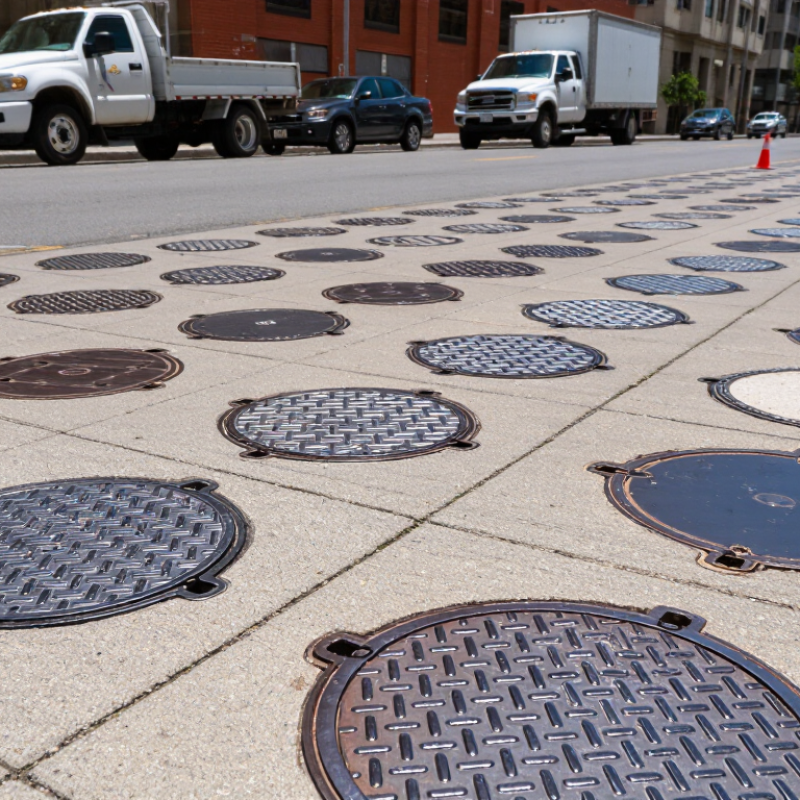
A manhole cover is a removable access panel over an underground chamber. It allows workers to inspect sewers, drainage lines, cables, and water networks. The frame supports the cover around its edge. Hinges, locking systems, and lifting points improve daily handling.
Most covers work through load transfer. Traffic pressure moves from the cover to the frame, then into the surrounding pavement. Ductile iron suits heavy roads because it combines strength with impact resistance. Steel can reduce weight, while reinforced concrete often fits large utility openings. Plastic composite covers resist corrosion and are easier to lift, but their long-term performance needs careful checking. EN 124 load classes help buyers match covers with locations, from pedestrian zones to heavy traffic areas. The wrong class may crack early. It happens.
The WHO and UNICEF Joint Monitoring Programme reported that 3.5 billion people lacked safely managed sanitation in 2022. Meanwhile, UN urbanization projections indicate that about 68% of people may live in cities by 2050. These figures show why access, drainage, and maintenance design matter. A cover is not just a lid; it is part of a working network.
Tips: Check the clear opening, load class, frame depth, locking method, and surface coating. Ask for test evidence, installation guidance, and replacement compatibility. Measure the chamber before ordering. A drawing can still hide a mismatch. 恒一
How Load Ratings Match Roads, Sites, and Traffic Conditions
2026 Best Manhole Cover Types for Global Buyers
Load ratings should match the road, not just the product sheet. A quiet footpath needs different protection than a freight terminal entrance. Light-duty covers suit pedestrian zones, landscaped areas, and private courtyards. Medium-duty models fit parking areas and slow-moving vehicles. Heavy-duty covers belong on public roads, loading bays, and industrial routes with repeated axle loads.
Traffic behavior matters as much as vehicle weight. A delivery van stopping over one cover creates impact stress. Turning trucks can twist the frame and damage weak seating surfaces. Buyers should check load class, clear opening, frame support, locking needs, and surface texture together. Regional standards may use different classifications, so compare test methods carefully. A familiar rating can still mislead when installation conditions differ.
Tips: Observe the site during its busiest hour. Measure vehicle speed, turning patterns, drainage, and pavement depth. Ask the installer how the frame will be bedded and leveled. A strong cover can fail when its frame sits on broken concrete. Avoid choosing only by maximum load; excessive weight can increase cost and complicate handling. Recheck access needs too. Maintenance teams may need safe lifting points, even on a quiet residential road. I have seen specifications look excellent on paper, yet poor seating caused noise and movement. Site evidence deserves more trust than a neat catalog table.
Safety, Standards, and Regional Requirements for Global Buyers
Choosing a manhole cover for global projects requires more than comparing load ratings. Safety depends on traffic conditions, installation quality, drainage design, and maintenance access. A cover beside a quiet sidewalk may need a different class from one placed on a freight route. EN 124 classifications, such as A15 through F900, are widely referenced, but buyers must verify the edition and testing method. Local authorities may require additional criteria.
Material selection also affects long-term reliability. Ductile iron offers high strength with manageable weight, while steel may suit customized structures when corrosion protection is carefully specified. Anti-slip patterns, secure locking, controlled opening, and ventilation features can reduce practical risks. In coastal areas, salt exposure demands stronger coating systems and inspection schedules. In cold regions, freeze-thaw movement can damage poorly seated frames.
Check the complete assembly, not only the lid. Frame alignment matters. So does the supporting concrete. Procurement teams should request test reports, dimensional drawings, installation guidance, and traceable quality records. Regional requirements may cover accessibility, noise reduction, fire routes, or utility-owner specifications. A familiar certificate is not automatically accepted everywhere. That assumption causes delays.
Field inspections often reveal a simple weakness: debris under the frame. Even a strong cover can rock, rattle, or fail when its support is uneven. Buyers should involve local engineers before ordering large quantities. Standards guide decisions, but site evidence must challenge them. Perhaps this step is still underestimated.
2026 Best Manhole Cover Types for Global Buyers
Safety, standards, and regional requirements by EN 124 load class
How to read the chart: EN 124 load classes indicate the minimum test load used to classify access covers. Higher classes are intended for areas exposed to heavier traffic and greater wheel loads.
Regional purchasing note: European projects commonly specify EN 124 classes. In the United States and Canada, municipal projects may reference AASHTO M306, while ASTM A48 generally addresses cast-iron material grades rather than equivalent traffic-location classes. Australia and New Zealand commonly use AS 3996. Buyers should confirm the required standard, clear opening, material, corrosion protection, locking features, and local authority requirements before selection.
How to Compare Costs, Durability, and Installation Needs
For global buyers, manhole cover cost should include freight, lifting equipment, labor, and future replacement. The U.S. EPA’s 2023 DWINSA estimates $625 billion in drinking-water infrastructure needs over 20 years. A small cover can protect a very expensive network. Cheap purchasing often becomes costly after repeated breakage.
Load class is the practical starting point. EN 124 identifies classes such as B125 for pedestrian areas and D400 for heavy traffic zones. Match the class to real vehicle loads, not only the project drawing. Ductile iron offers strong load performance and familiar installation methods. Composite covers can reduce handling weight and corrosion concerns. However, their long-term behavior varies with resin, reinforcement, heat, and local drainage conditions. The Global Infrastructure Hub reports continuing pressure on infrastructure investment, so lifecycle value matters more than unit price. It is a useful warning, not a perfect buying formula.
Installation details can change the final budget. Check frame depth, seating tolerance, hinge direction, locking design, and lifting access before shipment. A cover that arrives five millimeters too deep may require costly concrete adjustment. Measure the existing chamber twice. Field experience also shows that poor bedding creates rocking, noise, and edge damage. The ASCE 2025 Infrastructure Report Card gives U.S. wastewater infrastructure a D+ rating, reinforcing the need for maintainable components. I would still question every generic lifespan claim. Soil chemistry, traffic, flooding, and maintenance schedules can overturn laboratory expectations.